Dana Ludwig · 19 September 2026
Genetic Mapping Emerges as Key Tool for Safeguarding Mountain Oak Populations
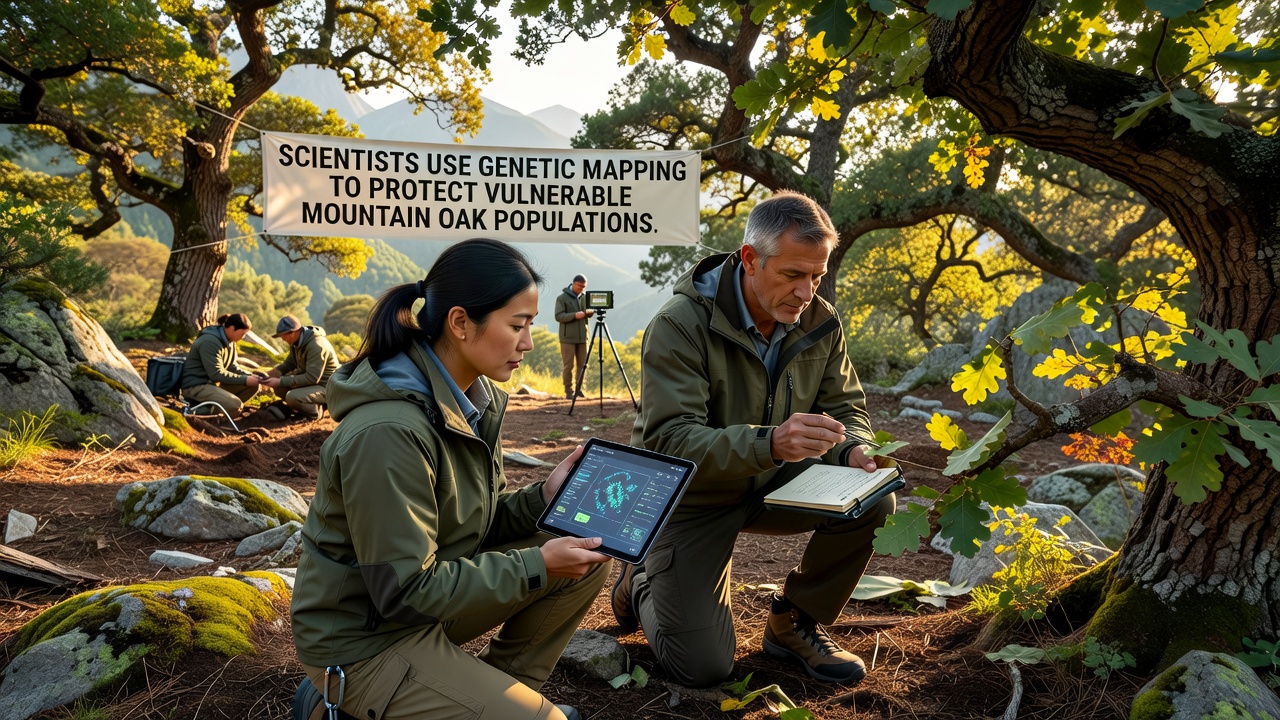
Scientists have turned to genetic mapping techniques to identify and protect vulnerable mountain oak populations across elevated terrains, where changing climate patterns and habitat pressures have intensified over recent decades. Research teams from multiple institutions began systematic sampling programs in 2023, and data collection continues through field seasons that extend into September 2026 at several long-term monitoring sites.
Genetic mapping allows researchers to chart variations in DNA sequences across individual trees and stands, revealing patterns of diversity that determine how well populations might withstand drought, temperature shifts, and disease outbreaks. One study released by the Canadian Forest Service in partnership with university labs showed that certain mountain oak lineages carry markers linked to improved water-use efficiency, information that helps guide where seeds should be collected for future plantings.
Understanding Genetic Diversity in High-Elevation Oaks
Mountain oak species often occupy fragmented habitats at higher altitudes, and these isolated groups frequently exhibit lower levels of genetic variation than their lowland counterparts. Observers note that reduced diversity can limit a population's ability to adapt when environmental conditions change rapidly. Teams working in the Rocky Mountains and similar ranges have used whole-genome sequencing to compare hundreds of samples, producing detailed maps that highlight which stands retain higher heterozygosity and which ones show signs of inbreeding.
Those maps serve practical purposes. Foresters and land managers consult the data when selecting source trees for restoration projects, choosing individuals that carry traits associated with resilience rather than relying solely on geographic proximity. Evidence from European mountain ranges, including work coordinated by the Swiss Federal Institute for Forest, Snow and Landscape Research, indicates similar approaches have improved survival rates in trial plantings by 15 to 20 percent compared with unselected stock.
Field Methods and Data Collection
Researchers typically begin by recording precise location data for each sampled tree using GPS units accurate to within a few meters. Leaf tissue or cambium samples are then collected and preserved for laboratory analysis. Once sequences are generated, bioinformatics pipelines align the reads against reference genomes and call variants across thousands of loci. The resulting datasets reveal population structure, gene flow between stands, and signatures of selection that may relate to local adaptation.

What's interesting is how quickly the technology has become more accessible. Portable sequencers now allow preliminary genotyping to occur closer to remote field sites, reducing the time between collection and initial results. Australian researchers studying eucalypt analogs have shared protocols that mountain oak teams adapted, demonstrating how cross-continental collaboration speeds method refinement. Data from these efforts feed into larger databases maintained by institutions such as the U.S. Department of Agriculture's Agricultural Research Service, where public access supports additional analyses by independent groups.
Applications in Conservation Planning
Conservation plans increasingly incorporate genetic information when designating priority areas for protection or when designing corridors that facilitate natural gene exchange. In regions where mountain oaks face pressure from expanding recreational development or shifting fire regimes, maps help identify source populations that could supply material for assisted migration trials. One project in the Pacific Northwest used genetic clusters to match seedlings with projected future climate conditions at target sites, rather than assuming current local provenances would remain suitable.
Those who've studied this process observe that combining genetic data with environmental modeling produces more robust predictions than either approach alone. For example, researchers at the University of British Columbia integrated genomic estimates of drought tolerance with downscaled climate projections, producing maps that flag areas where certain genotypes may become maladapted by mid-century. Such outputs guide decisions about which populations warrant extra monitoring or ex-situ conservation in seed banks.
Challenges and Ongoing Developments
Despite rapid progress, several technical and logistical hurdles remain. High-quality reference genomes are still limited for some mountain oak species, which complicates variant calling and functional annotation. Funding cycles and permitting requirements can also slow the pace of fieldwork in sensitive habitats. Yet collaborative networks that span government agencies, universities, and nonprofit organizations have helped distribute both costs and expertise more evenly.
September 2026 marks the scheduled release of an updated global database that will compile mountain oak sequences from North America, Europe, and parts of Asia into a single searchable platform. Early test versions already allow users to query allele frequencies across latitude and elevation gradients, providing a foundation for meta-analyses that were previously impractical.
Conclusion
Genetic mapping supplies conservation practitioners with concrete information about the hidden variation within mountain oak populations, enabling more targeted protection and restoration strategies. As datasets grow and analytical tools improve, the approach is expected to integrate further with remote sensing, climate modeling, and traditional ecological knowledge. Continued investment in sampling, sequencing infrastructure, and cross-border data sharing will determine how effectively these methods scale to address ongoing environmental pressures.