Parker Vogel · 3 October 2026
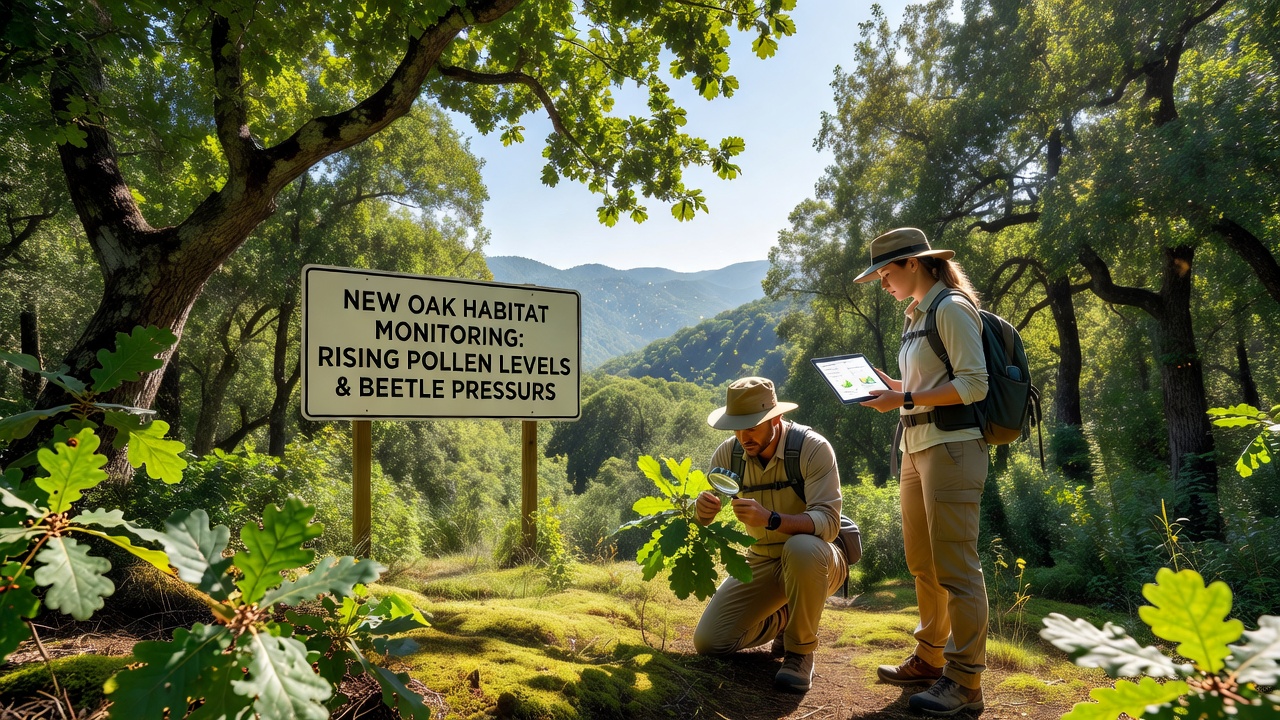
Rising Pollen Levels and Beetle Pressures Prompt New Oak Habitat Monitoring in Mountain Regions
Researchers across several mountain ranges have documented elevated pollen concentrations alongside increased beetle activity, and these combined factors have led agencies to expand habitat monitoring programs for oak populations in high-elevation zones. Data collected through 2025 shows pollen counts rising by as much as 35 percent in certain watersheds compared with averages from the previous decade, while beetle infestation rates have climbed steadily in stands previously considered stable.
Pollen Dynamics in Elevated Terrains
Pollen production in mountain oaks responds to shifts in temperature and moisture patterns, and observers note that warmer spring conditions often extend the flowering window while boosting output per tree. Studies from multiple field stations indicate that these longer seasons contribute to denser airborne particle loads, which in turn affect visibility for aerial surveys and complicate efforts to track tree health from a distance. Equipment upgrades including finer mesh filters on collection traps have become standard practice, and crews now calibrate sensors more frequently to account for the heavier loads.
October 2026 marks the start of a coordinated sampling round across sites in the northern Rockies and select European ranges, where teams will compare pollen viability rates against historical baselines maintained by forestry departments. This timing aligns with post-growing-season assessments, allowing researchers to correlate summer pollen peaks with subsequent seed development metrics.
Beetle Activity and Habitat Stress
Beetle populations, particularly species that target oak bark and foliage, have shown accelerated reproduction cycles in warmer microclimates, and pressure on individual trees increases when pollen-stressed oaks divert resources away from defensive compounds. Field reports describe galleries forming earlier in the season than recorded five years ago, prompting adjustments in trap deployment schedules and pheromone lure formulations used by monitoring crews. In one documented case, stands in mid-elevation transition zones experienced a 22 percent rise in visible damage between successive annual visits.

Expanded Monitoring Protocols
Agencies have responded by installing additional sensor arrays that measure both atmospheric pollen and beetle flight patterns in real time, and these networks feed into centralized databases maintained by regional forestry services. Protocols now require quarterly ground-truthing visits rather than the previous biannual schedule, while drone-based multispectral imaging supplements manual counts of infested branches. Collaboration with academic groups has introduced machine-learning models that predict outbreak likelihood based on pollen load thresholds combined with temperature anomalies.
Funding streams supporting these initiatives draw from both national resource management budgets and cross-border research grants, and international partners contribute standardized data formats that allow comparisons across continents. One initiative coordinated through a North American forestry coalition links monitoring stations in the United States with counterpart sites in Canada, whereas a parallel effort in the Alps involves EU-funded stations that share protocols with Australian alpine research teams.
Integration with Broader Conservation Data
Monitoring results feed directly into habitat suitability models, and updates scheduled for late 2026 will incorporate the latest pollen and beetle metrics to refine protection zones. According to reports from the U.S. Forest Service, revised maps will highlight corridors where intervention such as targeted thinning or biological controls may become necessary. European counterparts through the European Environment Agency have adopted similar modeling frameworks, which helps identify transcontinental patterns in oak stress responses.
Technicians emphasize that continuous data streams remain essential because short-term fluctuations in pollen or beetle numbers can mask longer-term trends, and only sustained observation reveals whether current pressures represent temporary spikes or structural shifts in mountain ecosystems.
Conclusion
Heightened pollen levels and beetle pressures have converged to necessitate more intensive oak habitat monitoring across mountain regions, and the programs now underway combine traditional fieldwork with advanced sensing technologies to capture these dynamics. Continued data collection through October 2026 and beyond will clarify how these factors interact over multiple seasons, providing the factual foundation required for adaptive management decisions.